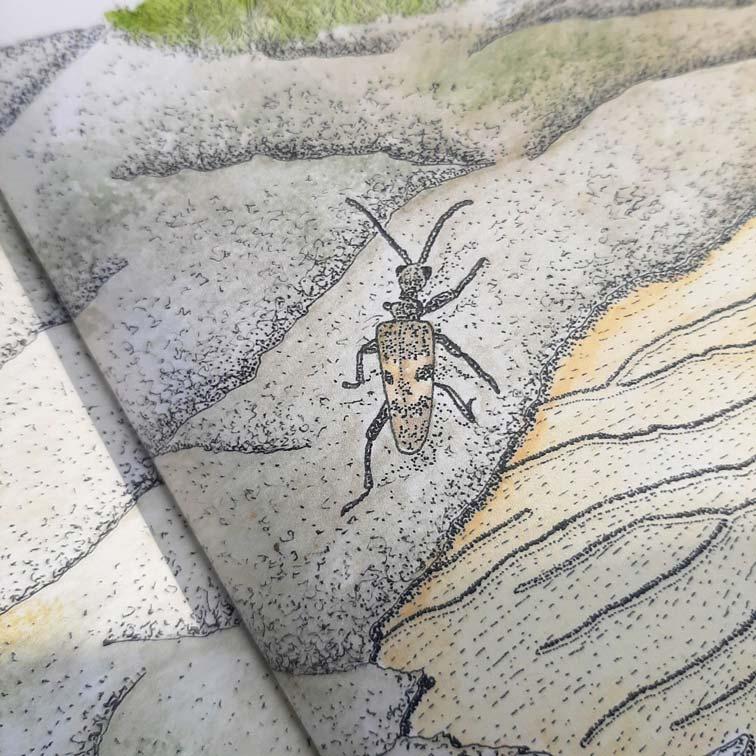
Black-spotted Longhorn Beetle (Rhagium mordax)
One of 69 species of Longhorn beetle (Cerambycidae) found in Britain; 30,000 worldwide. The larvae of most Longhorn beetles are wood-borers, sometimes taking years to develop under the bark of decaying wood, playing an important role in nutrient recycling. The adults are pollinators, feeding on a variety of woodland flowers.
Rhagium mordax is widespread and common throughout Britain and Europe. You are unlikely to see the larvae, which live and feed under the bark of Ash and other broadleaf dead wood. You may see the trail patterns of these and other wood-borers, which become visible on dead wood when bark falls off. They emerge as adults after around 2 years, in April or May. The adults can be seen up to August, on the surface of dead wood from where they have emerged, in flight, or feeding on Hawthorn blossom, Elder, Cow Parsley and other open flowers.
Longhorn beetles are generally relatively large (up to about 22mm in the case of Rhagium mordax) and have a distinctive elongated body shape, often broader at the shoulders and long legs. The 'horns' (antennae) are often much longer than those of Rhagium mordax.
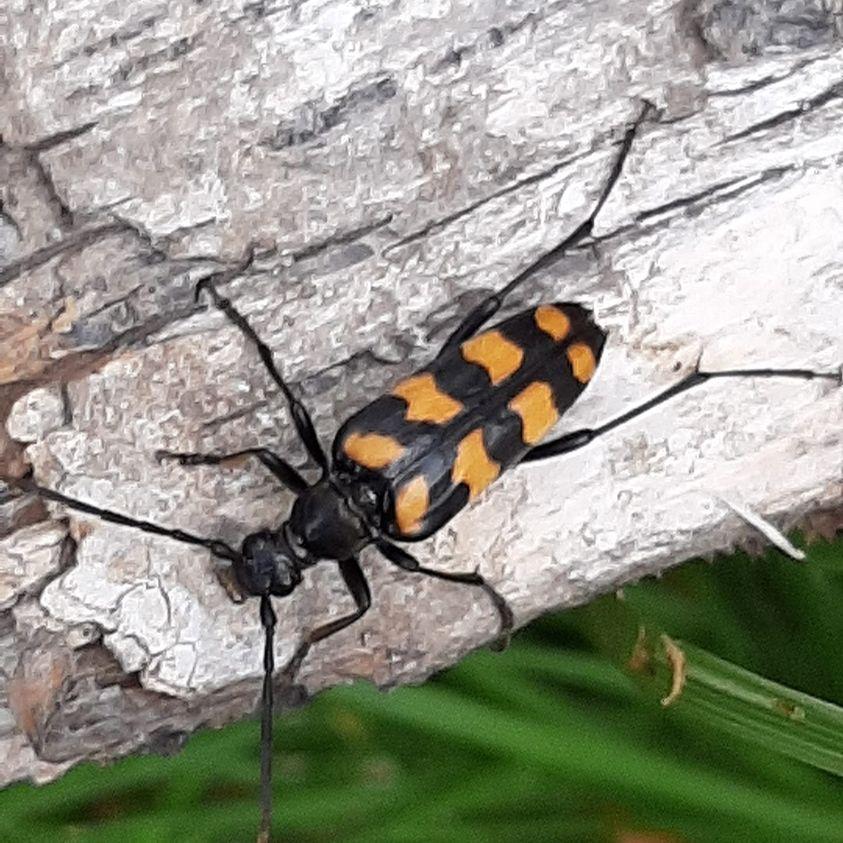
Another widespread and distinctive Longhorn beetle, with a similar life history, is this Four-banded Longhorn Beetle (Leptura quadrifasciata).
We introduce Longhorn beetles and other woodland species, in 'The Tree That Held The Moon' to inspire curiosity and give readers the opportunity to expand their nature vocabulary. Stories are a fantastic way to introduce children to new words and ideas in a fun way. They provide the opportunity for children - and adults - to infer the meanings of words that they do not know; stories help children develop their vocabulary by making connections between known and unknown words.